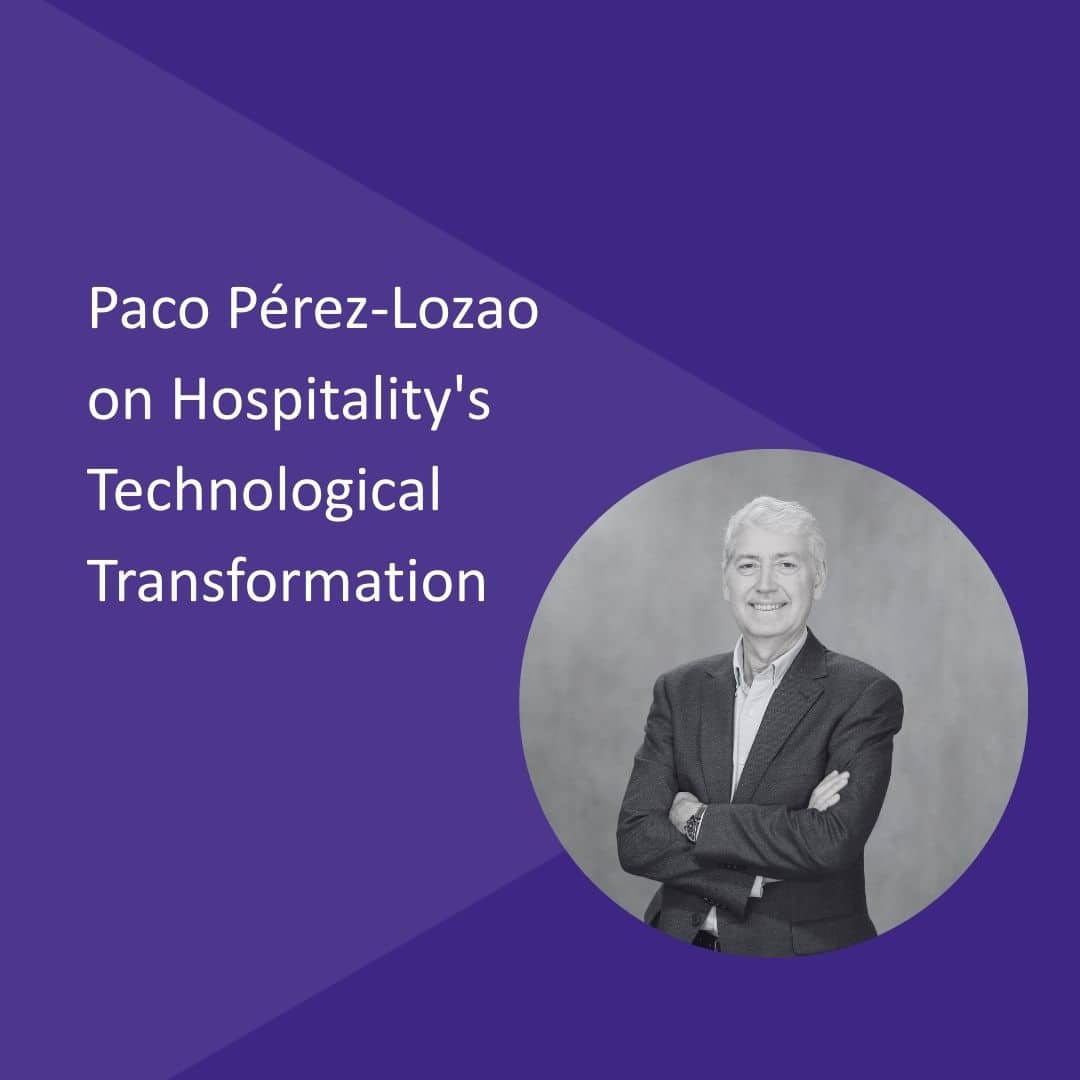
# From GDS to Guest Experience: Paco Pérez-Lozao on Hospitality’s Technological Transformation
*Amadeus’ President of Hospitality shares insights on moving beyond fragmented systems, the shift from transaction-centric to traveller-centric models, and why 2026 will test whether agentic AI can deliver on its promise*
Paco Pérez-Lozao has spent more than three decades at Amadeus, witnessing the company’s evolution from a global distribution system provider into one of the most influential technology platforms in travel. His journey has taken him from leading expansion into Eastern Europe after the collapse of the Soviet Union, through corporate strategy and M&A following Amadeus’ 2011 IPO, to his current role as President of Hospitality, where he oversees one of the company’s most strategic pillars.
In a recent conversation on the Setting the PACE podcast, Pérez-Lozao offered a candid assessment of hospitality’s technological maturity, the barriers preventing true personalisation at scale, and the strategic decisions both technology providers and hotel groups must make to succeed in an increasingly connected, AI-driven market.
His perspective is particularly valuable given Amadeus’ unique position spanning distribution, core property systems, data analytics and digital media. Where many technology companies focus on a single piece of the hospitality tech stack, Amadeus sees the entire ecosystem and the friction points that prevent it from working cohesively.
## The Fragmentation Challenge: Technology Islands in a Connected World
From Pérez-Lozao’s vantage point, hospitality faces a fundamental structural challenge that distinguishes it from other travel sectors. “From a technology perspective, hospitality is highly fragmented,” he explains. “You have property owners, management companies, brands, a very complex structure.”
This fragmentation manifests in multiple dimensions. Organisationally, the separation between ownership, management and brand creates misaligned incentives around technology investment. Technologically, hotels operate what Pérez-Lozao calls “technology islands”, disconnected systems that cannot share data or coordinate execution effectively.
Amadeus saw an opportunity to bring technology at scale to reduce friction and help the industry advance. But Pérez-Lozao is careful to distinguish hospitality’s needs from aviation’s model. “Not by copying airlines, but by supporting hospitality’s own evolution,” he emphasises.
The company’s approach focuses on four core areas. Distribution extends beyond traditional global distribution systems into leisure channels and emerging AI-driven travel planning environments. Core IT platforms centre on building next-generation, data-centric property management and central reservation systems designed for the generative AI era. Data and analytics capabilities are expanding through new sources and AI-driven insights that move beyond descriptive reporting to predictive and prescriptive intelligence. Digital media serves as both a revenue stream and a testing ground for digital merchandising, understanding personas, packaging relevant options, pricing dynamically and delivering results in milliseconds for higher conversion.
## From Transactions to Travellers: Rethinking the Data Model
One of the most significant shifts Pérez-Lozao identifies is the industry’s necessary evolution from a transaction-centric model to a traveller-centric one. The distinction is more than semantic.
Most hotel companies excel at capturing transactional data: bookings, check-ins, payments, stays. This information helps them understand what happened but provides limited insight into why it happened or what might happen next. “Many hotel companies rely on transactional data but lack visibility into consumer behaviour: how guests shop, where they drop off, and how they buy,” Pérez-Lozao observes.
This gap becomes particularly problematic as the industry attempts to deliver sophisticated digital merchandising and personalisation. To sell the right experience to the right guest at the right moment, hotels need to understand context and intent, not just transaction history.
Consider a business traveller whose flight has been delayed. A transaction-centric system treats check-in as a fixed process that begins at a predetermined time. A traveller-centric system recognises the delay, adjusts expectations accordingly, perhaps offering late check-in without requiring the guest to request it, and potentially suggesting dining options near the airport for the unexpected wait.
Different personas require fundamentally different approaches. A family travelling with young children has entirely different needs, pain points and value drivers than a business traveller or a couple on a romantic getaway. Yet most hotel systems treat these personas identically until the moment of arrival, missing opportunities throughout the shopping, booking and pre-arrival journey.
“Guests are no longer just booking a room; they expect experiences across their entire journey,” Pérez-Lozao explains. “That means understanding context. Different personas require different approaches. This is where a connected journey becomes essential.”
## The Connected Journey: Where Hospitality Stands
The concept of a “connected journey” has become something of an industry buzzword, but Pérez-Lozao offers a sobering assessment of actual progress. When asked to rate hospitality’s maturity on a scale of one to ten, his answer is blunt: “In aviation, airports and border control, we may be at three or four out of ten. In hospitality, I’d say we’re closer to zero or one.”
There are exceptions. Dubai, for instance, is designing seamless, biometric-based experiences that connect airports and hotels, allowing guests to move through check-in, security, border control and hotel registration with minimal friction. But these remain outliers rather than the norm.
The barriers to connectivity are both technical and organisational. Technically, many hotels still operate on legacy, on-premise systems that cannot easily share data or coordinate real-time decisioning across touchpoints. “Today, many hotels operate as technology islands,” Pérez-Lozao notes. “Cloud adoption is a major enabler here. Without cloud-based PMS and CRS systems, it’s very difficult to deliver sophisticated, real-time use cases.”
But cloud migration alone doesn’t solve the problem. Equally critical is data architecture. One of the biggest barriers to AI adoption, Pérez-Lozao argues, is simply that data isn’t properly accessible. Hotels may have massive amounts of information across reservation systems, property management platforms, point-of-sale systems, loyalty databases and marketing platforms, but if that data isn’t unified, structured and accessible, it cannot power the intelligent experiences guests increasingly expect.
Organisationally, the challenge is that connected journeys require cross-functional coordination that most hotel organisations aren’t structured to deliver. Marketing, sales, revenue management, operations and guest services each operate with separate systems, metrics and priorities. Creating seamless experiences requires these functions to work as integrated teams around guest outcomes rather than departmental objectives.
## Build, Partner or Acquire: Strategic Choices in a Fast-Moving Market
As both a technology provider and an acquirer of hospitality technology companies, Amadeus faces the same strategic question it helps hotel clients navigate: when should you build capabilities internally versus partnering with or acquiring external providers?
Pérez-Lozao acknowledges there’s no single answer. “We constantly evaluate hundreds of companies and work closely with major tech players like Google, Microsoft and Salesforce,” he explains. The company’s approach balances several competing considerations.
The first principle is customer flexibility. “We must integrate with many partners,” Pérez-Lozao emphasises. “We won’t force hotels to change core systems unnecessarily.” This means Amadeus cannot simply build proprietary, closed platforms that require customers to adopt every component. Integration capabilities become as important as core functionality.
The second consideration is speed to market. In areas where a capability is strategically core and timing is critical, acquisition may accelerate delivery by years compared to internal development. “Often, it’s less about money and more about speed,” Pérez-Lozao notes.
The third factor is market maturity and competitive intensity. In highly commoditised areas where multiple capable providers already exist, partnering often makes more sense than building or buying. In emerging areas where capabilities are nascent and strategic importance is high, building or acquiring may be justified.
This same logic applies to hotel companies making technology decisions. Pérez-Lozao observes that many mid-sized brands still build too much in-house, spreading development resources across too many initiatives rather than focusing internal effort on true differentiators. “You need to be selective, focus internal effort on true differentiators and rely on partners elsewhere,” he advises. “Otherwise, you lose agility in a world where technology evolves daily.”
The implication is that technology strategy requires clear-eyed assessment of what truly differentiates your offering versus what is necessary but not differentiating. Build the former, partner for the latter, and avoid the middle ground where you’re building commodity capabilities that distract from strategic priorities.
## Global Market Outlook: Growth Shifting East
Pérez-Lozao’s perspective on global demand reflects Amadeus’ position working with hotels across every major market. The picture for 2025 in Western markets has been relatively flat, with RevPAR growth around 2% and stable occupancy. North America has experienced particular pressure, including reduced government travel that affected certain markets disproportionately.
The stronger growth stories are in Asia-Pacific and the Middle East. “Long term, we believe two-thirds of industry growth will come from Asia,” Pérez-Lozao projects. The scale is already significant: “China is now the second-largest hospitality market globally by volume.”
This geographic shift has profound implications for technology strategy. Systems designed primarily for Western markets may not address the payment preferences, distribution channels, guest expectations or regulatory requirements dominant in Asian markets. Hotels competing globally need technology platforms that can accommodate regional variations whilst maintaining coherent global guest profiles and operational standards.
Looking ahead to 2026, Pérez-Lozao expresses caution. “2026 looks uncertain due to geopolitical instability and trade barriers,” he notes. The macroeconomic and geopolitical environment creates volatility that makes planning difficult, particularly for hotel groups with significant international exposure.
## Evolving Traveller Expectations: Personalisation, Immediacy and Influence
Beyond demand volumes, Pérez-Lozao identifies three significant shifts in how travellers engage with hotels. First, expectations have moved decisively towards personalised, experience-led stays. “Anything too transactional falls short,” he observes. Guests don’t simply want a room; they want experiences that reflect their preferences, anticipate their needs and deliver memorable moments that justify premium pricing.
Second, immediacy has become non-negotiable. “Everything must be instant and mobile-enabled,” Pérez-Lozao explains. This extends beyond mobile check-in and digital keys to every interaction throughout the guest journey. Waiting for responses, navigating complex processes or being forced to engage through channels that aren’t convenient creates friction that guests increasingly won’t tolerate.
Third, the influence patterns shaping travel decisions have shifted dramatically. “Social media and AI tools are increasingly influencing travel planning and discovery,” Pérez-Lozao notes. Traditional marketing channels still matter, but the consideration journey now often begins with content discovered through social platforms, recommendations from influencers, or AI-generated suggestions that synthesise information from multiple sources.
This last shift has profound implications for how hotels think about distribution, marketing and content. When AI agents become the primary interface through which travellers discover and evaluate options, hotels need to ensure their content, pricing and availability integrate seamlessly into these new channels, a challenge Pérez-Lozao describes as the emerging “agentic world.”
## Artificial Intelligence: Three Opportunity Areas
Pérez-Lozao identifies three distinct areas where artificial intelligence offers opportunities for hospitality, each requiring different capabilities and delivering different value.
The first is engaging with AI agents as new search and planning channels. This represents a fundamental shift in distribution strategy. Rather than guests searching hotel websites or online travel agencies directly, they increasingly use AI-powered planning tools that analyse their preferences, constraints and context to suggest appropriate options. For hotels, this means ensuring their inventory, content and pricing integrate into these agentic platforms and that their offerings can be accurately represented and recommended by AI systems that understand guest intent.
The second opportunity is operational automation, removing manual, low-value tasks that consume staff time without enhancing guest experience. Examples range from automated responses to routine enquiries to intelligent workflow management that routes tasks to appropriate team members based on context, skills and availability. The value isn’t simply cost reduction but freeing staff to focus on high-value interactions that require human judgment, empathy and creativity.
The third area is digital merchandising and hyper-personalisation, combining attributes, dynamic pricing and real-time decisioning to present each guest with offers optimised for their specific needs and context. This extends beyond room selection to ancillary services, upgrades, dining options and experience packages tailored to individual preferences and delivered at moments when propensity to purchase is highest.
Crucially, Pérez-Lozao emphasises that these opportunities cannot be realised without foundational capabilities in place. “To do this effectively, hotels need a modern tech stack and unified data,” he explains. Companies rushing to implement AI tools without first addressing data fragmentation and legacy system constraints will achieve limited results.
## Loyalty Evolution: Beyond Points to Lifestyle Ecosystems
The evolution of loyalty programmes represents another area where Pérez-Lozao sees significant transformation underway. Traditional points-based programmes remain important but increasingly insufficient to drive emotional engagement and preference.
“Loyalty programmes are evolving beyond points into broader lifestyle ecosystems,” Pérez-Lozao observes. “The goal is emotional engagement and experience, supported by AI-driven, data-led personalisation.”
This shift reflects changing consumer expectations, particularly among younger travellers who value experiences, access and recognition over purely transactional rewards. Successful loyalty programmes are expanding beyond hotel stays to encompass dining, entertainment, wellness and experiential offerings that create lifestyle value across multiple touchpoints.
The broader ecosystem approach also creates opportunities to connect more of the travel journey. When loyalty platforms extend to destination content, local experiences and partner services, they provide the connective tissue that can link discrete elements into coherent journeys, addressing the fragmentation challenge Pérez-Lozao identified earlier.
AI enables this evolution by making personalisation scalable. Rather than generic offers broadcast to broad segments, AI-driven systems can analyse individual behaviour, preferences and context to deliver truly personalised recommendations and rewards that feel relevant rather than intrusive.
## What Winning Companies Do Differently
When asked what separates leading hospitality companies from laggards, Pérez-Lozao outlines several distinguishing characteristics that align closely with the strategic imperatives outlined in PACE Dimensions’ analysis of winning strategies for 2026.
Leading companies treat technology as core strategy, not simply as operational support. Technology decisions are made at the highest levels with clear alignment to business objectives rather than delegated to IT departments operating independently from commercial strategy.
They put data and travel intelligence at the centre of decision-making. Rather than relying on intuition or historical patterns, winning companies invest in customer intelligence that reveals propensity to buy, preference patterns and contextual needs that inform everything from pricing to experience design.
They connect revenue management and media, recognising that these functions must work in integrated ways to optimise both demand generation and yield management. The traditional separation between marketing (driving demand) and revenue management (optimising yield) creates suboptimal outcomes when these functions operate independently.
They deliver experience-led personalisation consistently across touchpoints. This requires the cross-functional coordination and unified data architecture Pérez-Lozao emphasised throughout the conversation.
They build connected ecosystems rather than technology islands. This means making architectural decisions that prioritise integration, data sharing and coordinated execution over functional optimisation within departmental silos.
They monetise beyond the room, recognising that guest spending on dining, wellness, experiences and ancillary services often represents higher-margin revenue than room rates alone. This requires systems that can merchandise these offerings effectively throughout the guest journey.
They embrace contactless convenience whilst maintaining human connection where it adds value. The goal isn’t eliminating human interaction but enabling guests to choose their preferred engagement model and ensuring staff focus on high-value moments rather than routine transactions.
They rethink loyalty as a lifestyle relationship rather than a transactional rewards programme, recognising that emotional engagement drives long-term preference more effectively than points accumulation.
## Looking Ahead: 2026 as a Testing Ground
Pérez-Lozao’s outlook for the year ahead reflects cautious optimism tempered by significant uncertainty. Geopolitical instability, trade tensions and economic volatility create unpredictable demand patterns that complicate planning and investment decisions.
But 2026 will also serve as a crucial testing ground for one of the industry’s most hyped developments: agentic AI models that promise to transform how travel is searched, planned and booked. “2026 will test whether AI-driven agentic models can truly deliver on their promise,” Pérez-Lozao observes.
The industry’s ability to absorb and effectively deploy these technologies remains an open question. Pérez-Lozao notes that “hospitality tech adoption is slower than in other sectors, for valid reasons.” The complexity of operations, the capital intensity of system replacement, the organisational change required and the need to maintain service continuity all create natural friction that slows adoption.
Yet standing still isn’t an option. The gap between leaders and laggards will widen as some companies build the foundational capabilities, data architecture and operating models required to exploit AI effectively whilst others pursue disconnected pilots that cannot scale or deliver sustained value.
From his position leading hospitality strategy at one of the industry’s most influential technology providers, Pérez-Lozao sees the transformation clearly: hospitality is moving from a transaction-centric, room-focused business model to a traveller-centric, experience-led approach enabled by connected systems, unified data and intelligent automation.
The companies that recognise this shift and make the difficult architectural, organisational and strategic decisions it requires will thrive. Those that continue optimising legacy approaches will find themselves increasingly unable to compete on the dimensions guests care about most: personalised experiences, seamless journeys and authentic engagement that extends beyond the transaction.
After three decades in travel technology, Pérez-Lozao’s perspective carries the weight of someone who has witnessed multiple waves of industry transformation. His message is clear: the current wave, driven by AI, cloud platforms and changing consumer expectations, represents not incremental change but fundamental reimagining of how hospitality creates and delivers value. The time for preparation is now.
—
**Meta description:**
PACE interviews Paco Pérez-Lozao, President of Hospitality at Amadeus, exploring fragmented hotel tech, traveller-centric transformation, and AI’s impact on hospitality.