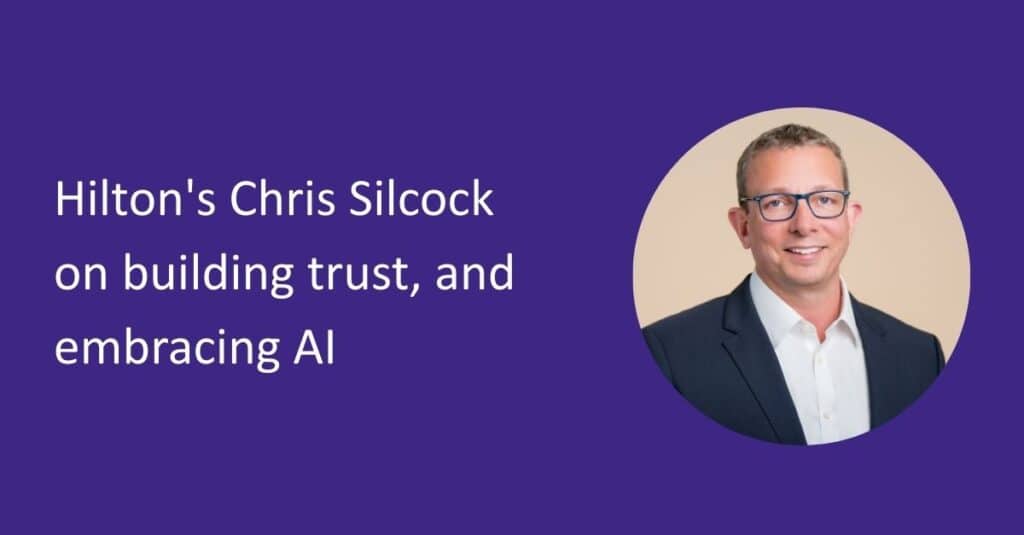
Hilton’s Chris Silcock on building trust, and strategic imperatives facing the industry
As artificial intelligence fundamentally transforms how consumers discover and book travel, one message emerges with striking clarity from leading travel and hospitality management consultancy PACE Dimensions’ conversation with Ailish English, Industry Head for Travel at Google: the brands that win won’t necessarily be the biggest—they’ll be the ones that get AI-ready first.
One thing becomes immediately apparent within minutes of speaking with Chris Silcock: his three-decade journey at Hilton, from part-time banquet waiter to his current role overseeing 25 global brands, has given him a perspective on technological disruption that few in the hospitality industry can match. The seasoned executive brings unique insight to his role, having witnessed first-hand how digital transformation can reshape competitive dynamics and he’s adamant that hospitality stands at its most pivotal inflection point yet.
Silcock offers a perspective shaped by unusual longevity in an industry known for executive mobility. His career arc, entirely within one company, spanning roles from property operations through revenue management, sales, marketing, distribution, and now brand leadership, has given him a comprehensive view of how hospitality actually works when strategy meets operational reality.
What becomes immediately apparent is that Silcock’s thinking defies the binary frameworks that dominate industry discourse. Where others see technology versus human service, he sees technology enabling better human service. Where others worry about OTA dominance, he focuses on brand strength. Where others chase the latest AI capabilities, he asks what business problems need solving first.
The accidental hotelier who stayed
Silcock’s entry into hospitality carried none of the romantic narratives that often accompany industry leadership profiles. He wasn’t pursuing a lifelong passion or following family tradition. He was studying for a master’s degree in music and needed money.
“I was studying for a master’s in music and I took a part-time job as a banquet waiter at my local Hilton, the Hilton Watford in the UK,” Silcock recalls. The position was meant to be purely transactional: earn cash, complete studies, move on.
What happened instead reveals something fundamental about hospitality’s unique appeal. “I very quickly kind of fell in love with the industry, being part of that team on a hotel,” Silcock explains. The immediate satisfaction of creating experiences, the camaraderie of hotel operations, the tangible impact on guests: these elements proved more compelling than any career plan.
More significantly, Hilton kept providing opportunities for growth. “Hilton just kept offering me opportunities to do something different or more, or learn a new skill,” Silcock notes. That pattern of continuous learning and new challenges has characterised his entire career, transforming an accident into a deliberate journey of increasing responsibility.
His path through revenue management into sales, marketing, and distribution, culminating 18 months ago with brand leadership, has created something rare: a hospitality executive who understands the commercial engine of hotels from every angle.
The Hilton growth story: Geography and segments
Understanding Hilton’s trajectory over the past 15 years requires examining growth through two distinct but interconnected lenses. The company has expanded both geographically, reaching meaningful scale in China, India, the Middle East, and strengthening position in established markets like the UK, whilst simultaneously pushing into new customer segments that didn’t previously fit within its brand portfolio.
“We’ve always been in luxury and full service and focus service,” Silcock explains. The recent evolution has seen aggressive movement into lifestyle hospitality whilst making a first foray into premium economy, segments that enable Hilton to access entirely new customer bases.
The numbers tell a compelling story. Hilton has doubled its brand count to 25 over 15 years, now operating across 130 countries. Crucially, established brands with 50 or 100 years of history continue demonstrating strong growth trajectories in both mature and emerging markets.
This dual-engine growth strategy has created a portfolio that serves dramatically more customer occasions and needs than the Hilton of a decade ago. The company has systematically expanded its addressable market whilst maintaining the brand clarity and operational standards that underpin customer trust.
Three forces reshaping hospitality
When asked about the biggest forces shaping hospitality today, Silcock immediately identifies three interrelated dynamics: economic uncertainty, technological innovation, and evolving customer expectations. However, his analysis moves quickly past these familiar categories to more nuanced observations about how different travel segments are actually behaving.
The resilience of leisure travel has been one of hospitality’s most striking post-pandemic revelations. “Travel is just unstoppable and it’s very reassuring for the industry,” Silcock observes. The pattern has held regardless of what the world throws at the sector: customers simply won’t stop travelling, particularly for leisure purposes.
More significantly, recovery times from disruptions have accelerated. Where previous downturns might have seen extended recovery periods, consumers now return to travel behaviour far more rapidly, a structural shift that fundamentally alters risk calculations for the industry.
Business travel presents a more complex picture. Overall demand remains steady rather than growing, but Silcock identifies an important bifurcation within the segment. Large corporate travel varies over time as companies adjust travel policies and budgets. Small business travel, by contrast, proves far more resilient.
“Small businesses just have to travel, right? That’s how they make money, their bread and butter,” Silcock explains. This segment can’t simply reduce travel when economic conditions tighten.
Group travel fluctuates with economic conditions in predictable ways, currently experiencing a strength period. However, Silcock identifies technology as creating the most genuinely disruptive moment in hospitality’s recent history, particularly in how consumers dream about, shop for, and book travel.
The dreaming deficit: Technology’s next frontier
Silcock frames the technological revolution in hospitality through a surprisingly underexplored lens: the inadequacy of current tools for helping consumers dream about and plan travel experiences.
Previous technological evolutions provided access and transparency to the marketplace. Consumers gained unprecedented ability to see what hotels existed, compare prices, read reviews, and complete transactions efficiently.
“Whilst the last kind of big evolution provided access and transparency to the marketplace of what is available, if you really look at the process of dreaming for travel, especially leisure dreaming for travel, it’s really still quite immature,” Silcock argues.
The gap is substantial. Consumers want to express preferences (golf, fishing, coastal location, cultural attractions) and receive synthesised recommendations that match those preferences. Current tools force consumers to conduct this synthesis themselves.
Silcock sees AI transforming this experience fundamentally. “You’re going to be able to much more easily put together the three to five preferences that you have,” he explains. The resulting content will actually match dreaming needs rather than simply presenting overwhelming choice.
For hotels with genuinely compelling products and experiences, this represents profound opportunity. Properties that deliver authentic value will surface for highly qualified potential guests who actually want what they offer.
Trust and evolution: What customers want
Consumer preferences present an interesting duality: certain fundamentals remain constant whilst other dimensions evolve significantly.
The constants centre on trust and reliability. “They want a trusted partner who’s going to deliver the basics, a reliable and friendly stay every time, wherever they go,” Silcock states. Customers need confidence that when they arrive at a hotel, they’ll receive competent, friendly service and a properly functioning product.
This reality underpins Hilton’s competitive advantage. “That’s in part why Hilton does so well in all of our hotels,” Silcock explains. Customers trust that across any Hilton brand, they’ll encounter consistent service standards, product quality, and technology functionality.
However, preferences are simultaneously evolving. The appetite for lifestyle experiences, luxury offerings, and independent-feeling properties has grown substantially. Consumer research reveals a dominant motivation shaping contemporary travel behaviour.
“Almost 60% of travellers said their primary motivation is to rest and recharge,” Silcock shares. This orientation towards travel as restoration drives specific product preferences: larger spaces with suites and kitchens; pet-friendly hotels; partnerships with wellness brands like Peloton and Calm.
In the United States specifically, Silcock identifies a resurgence in road trip travel: families wanting the drive itself to constitute part of the vacation experience.
These evolving preferences don’t replace the need for trust and reliability; they build upon it. Hilton’s strategy recognises both dimensions, delivering consistent quality whilst expanding product offerings to meet emerging travel motivations.
Measuring what matters: RevPAR, satisfaction, and owner profitability
When discussion turns to performance metrics, Silcock identifies three measures that drive hospitality business success.
Revenue per available room, particularly relative RevPAR versus competitors, remains fundamental because it represents the starting point for profitability whilst serving as a lagging indicator of customer preference. When customers choose your hotel, RevPAR increases.
However, Silcock places equal if not greater emphasis on guest satisfaction. Hilton’s scale enables clear demonstration of the correlation between satisfaction and revenue. The principle couldn’t be simpler: make customers happy, make more money.
The third critical metric, one Silcock argues is “elevating in its importance”, is owner profitability and return on investment. Current conditions of low rate growth combined with high inflation in operating costs make owner economics particularly acute.
The sustainability logic is straightforward: when hotel economics don’t support profitable operations, owners cannot afford to reinvest in product quality. When reinvestment stops, the guest experience deteriorates. When experience deteriorates, guest satisfaction falls. When satisfaction falls, RevPAR suffers.
“If your owner can’t afford to reinvest, then of course your experience deteriorates,” Silcock explains. This interconnection makes owner profitability not merely a financial consideration but a fundamental driver of long-term brand health.
Breaking down silos: The organisational challenge
Silcock’s perspective on how AI will force different approaches to process design offers genuine insight. Traditional point solutions deliver real value: a better revenue management system improves pricing, enhanced marketing automation improves campaign efficiency.
However, Silcock argues forcefully that AI enables and requires a fundamentally different approach. “What AI will force us to do is look end-to-end across the entire process regardless of organisational function, functional silos, and work out how you completely re-engineer that whole process,” he explains.
This represents more than incremental improvement: it’s comprehensive reimagining of entire workflows from customer perspective rather than organisational structure.
“I think that’s one of the most exciting things, and I think it will be what differentiates those that get the most value over the next five years from AI enablement,” Silcock predicts. The companies that extract maximum AI value won’t be those with the most AI tools: they’ll be those that fundamentally rethink processes end-to-end.
This insight has particular relevance for hospitality, where customer journeys span multiple departments and functions. AI creates opportunity, and necessity, to reimagine the entire journey as a unified process.
AI’s impact: Already here, much more coming
Silcock’s perspective on artificial intelligence carefully balances enthusiasm about transformative potential with grounded understanding of where AI has already delivered value and where the most significant changes lie ahead.
AI’s influence on revenue management and pricing is already substantial. Marketing is experiencing growing AI impact through content creation and personalised delivery, improving both efficiency and effectiveness.
The dreaming phase, helping consumers imagine and plan trips, represents where Silcock sees the most significant evolution emerging. This transformation benefits both customers and hotels that deliver genuinely compelling experiences.
“We feel one of our insulation strategies against changing technology is ensuring that our hotels deliver the best product, service, and technology experience,” Silcock explains. When AI reshapes discovery and booking, properties with superior actual experiences will benefit disproportionately.
Beyond customer-facing applications, Silcock identifies substantial efficiency opportunities in back-office functions where AI can drive productivity improvements. On property, customer service applications are already emerging, with AI agent capabilities handling routine inquiries whilst freeing human staff for more complex guest interactions.
However, Silcock’s most important AI insight is definitional: understanding what AI should and shouldn’t replace in hospitality’s service delivery model.
“I’m a firm believer that people do business with people,” Silcock states emphatically. His philosophy on AI centres on enhancement rather than replacement. “AI is there to help me solve the business challenges I have in my own business.”
The distinction matters enormously. Approaching AI as a solution in search of problems leads to implementation for implementation’s sake. Approaching AI as a tool for solving identified business problems leads to strategic deployment that creates genuine value.
His conclusion on AI’s role in hospitality could not be clearer: “Ultimately, for us, we’re still a business, a physical business where customers arrive and will be served by our team members. So it will enhance that. It will never change or replace that.”
This represents more than corporate positioning: it’s a fundamental recognition of what hospitality actually is. Unlike purely digital businesses where AI might completely automate customer interaction, hospitality requires physical presence, human service, and emotional connection. AI can make those elements better; it cannot substitute for them.
Real-world applications demonstrate this principle. Four Seasons uses AI sentiment analysis across multiple review platforms to identify pain points systematically. Chatbot experiences continue improving. Companies deploy Vertex AI to enhance website services with richer planning detail.
Evidence from smart marketers who have embraced AI early shows substantial results: 60% uplift in output, meaningful efficiency gains extending beyond marketing into operational optimisation.
Brand strategy in a fragmented landscape
The proliferation of hotel brands creates understandable confusion about how consumers navigate choice. Silcock’s perspective reframes the question in ways that challenge conventional assumptions.
“We in the industry look at all our brands and say, ‘Gosh, how can a customer really understand them all?’” Silcock acknowledges. However, the industry view fundamentally misunderstands the customer perspective. “When you look at a customer, they don’t want to and they don’t need to.”
Customers don’t need comprehensive knowledge of every brand in a portfolio. They need familiarity with the three, five, or seven brands that meet their specific travel needs.
This insight enables Hilton’s brand-led strategy. “The most important thing is the branded experience a customer has,” Silcock explains. When companies succeed in delivering the strongest brands that customers genuinely prefer, customers actively seek them out regardless of competitive noise and technological change.
The physical nature of hospitality provides a structural advantage. “We actually still have to have the customer arrive and stay with us,” Silcock notes. This creates opportunity to deliver experience quality that cements preference and builds loyalty.
Hilton’s strategy bets that being the best place to stay matters more than having the most brands or the widest distribution. Get the branded experience right, and customers will find you.
Loyalty evolution: Beyond bribery
Silcock visibly bristles at characterising loyalty programmes as “bribery systems”, offering an immediate reframe: “I would maybe reposition it as a mutually beneficial relationship rather than bribery.”
Points remain critically important, especially for frequent travellers. The transactional element of loyalty will persist.
However, Silcock argues that points sit atop a foundation of experience quality. “The reason for loyalty in many parts is the quality of the experience,” he explains. Customers remain loyal to brands they trust will deliver friendly, reliable service every single time.
Technology evolution enables strengthening the relationship through personalisation. A growing dimension involves rewarding loyalty with access: to different ways to stay beyond core hotel offerings, to experiences customers value but couldn’t ordinarily access.
When asked whether future loyalty will be driven more by points or by personalisation and experiences, Silcock’s response refuses the binary framing. All elements matter. The core value proposition remains primary, built upon reliable service delivery. However, access to experiences and new ways to stay will grow in importance without overtaking traditional loyalty programme fundamentals.
Competing in the OTA era
The structural tension between direct hotel bookings and online travel agency distribution has persisted for two decades. When challenged about how hotels compete against OTAs’ enormous spending power, Silcock immediately reframes it as “an age-old problem” rather than a new AI-specific challenge.
OTAs possess real advantages. “They are more nimble. They often are more agile,” Silcock acknowledges. “And they spend a lot.”
However, his advice centres on fundamentals rather than attempting to outspend competitors. Hotels must clarify objectives and understand what they’re trying to achieve with available budgets.
Silcock advocates pragmatic coexistence strategies. “There is space for direct bookings and OTAs to play together and to win,” he notes. Hotels should be clear about where they want to push direct bookings and where OTA distribution makes strategic sense.
Website optimisation emerges as crucial in the AI-discovery paradigm. “If your website is really answering all of those questions, well then AI will surface your website and will show it, particularly in AI overviews,” Silcock explains. AI overviews are designed to deliver the best experience for users, creating genuine opportunity for direct booking when hotel websites provide superior information and value.
Traditional hospitality marketing operated on predictable seasonal patterns. Peak booking periods saw concentrated marketing activity and budget deployment. That model is dissolving.
“We’ve now seen that in the UK for travel, Black Friday’s becoming a much bigger thing,” Silcock observes. Companies are bringing forward sales and discounts. The booking period extends longer. The curve has flattened and spread.
AI accelerates this trend by making information accessible at any moment. Consumers can research, compare, and book whenever inspiration strikes.
His recommendation challenges fundamental assumptions about campaign-based marketing: “As long as you’re comfortable with your cost of sale, it should be always on because people are always in market to book a holiday.”
The shift is profound. Rather than concentrating budgets in burst campaigns during defined periods, effective marketing increasingly requires consistent presence optimised to cost-of-sale targets.
Collection brands: The independence paradox
Market consolidation continues reshaping hospitality’s competitive landscape. Hilton represents approximately 5% of global room supply but over 20% of hotels currently under construction worldwide.
However, independent hotels still constitute an enormous portion of global supply. Collection brands represent an elegant solution to the tension between consumer preference for trusted brands and desire for unique, independent experiences.
These brand families enable independent hotels to remain substantially independent, retaining individual character and local relevance, whilst gaining access to major brand platforms, technology infrastructure, and distribution capability.
“That’s a vehicle by which independents can remain independent and yet get the power of our Hilton engine,” Silcock explains.
Hilton’s recent launch of Outset Collection targets this opportunity in the upper midscale to midscale segment, extending collection brand strategy to properties that previously lacked access to major brand affiliation whilst maintaining their distinctive character.
Three imperatives for hospitality’s future
When asked for his top advice to hospitality leaders concerned about competitive positioning over the next two to three years, Silcock identifies three critical priorities.
First: Get AI-ready. This encompasses far more than purchasing AI tools. It requires systematic preparation across technology infrastructure, team capabilities, and organisational processes.
“Make sure that you are ready, your website is ready, that your teams are ready,” Silcock urges. Internal adoption matters substantially. Employee empowerment is crucial: “Make sure that your people are empowered to use them because actually you’re just gaining efficiency.”
Second: Understand your customers deeply. This requires organised, structured, actionable data rather than simply accumulating information without analytical capacity.
“In this era, understanding your customer is absolutely key,” Silcock states. However, data alone achieves nothing. “You need to have it organised. You need to have it structured, and you need to not just have the data, you need to be able to analyse it.”
Silcock identifies a common failure pattern: companies possess valuable customer data but don’t connect teams internally to ensure marketing, analytics, and distribution all benefit from customer understanding.
Third: Maintain agility. In an environment where AI enables rapid disruption, organisational agility functions simultaneously as defensive necessity and offensive capability.
Silcock shares a revealing conversation with a CMO who identified his greatest competitive concern not as established competitors but as potential disruptors. “It’s a new company that’s just going to come along and it’s going to be small, it’s going to be agile and it’s going to really disrupt our business.”
AI enables precisely this kind of disruption. “That’s what AI is actually enabling companies to do, which is really exciting,” Silcock notes. “But it does mean that everybody needs to keep on their toes as well.”
Career philosophy: Focus on the game, not the scoreboard
When asked for guidance for people entering hospitality, Silcock identifies a pattern he sees repeatedly: professionals who focus constantly on the scoreboard, always seeking the next win.
“I always advise against that,” Silcock states firmly. His alternative approach centres on enjoying your work and focusing on the game itself: delivering excellent results in your current responsibilities, working effectively with colleagues, maintaining quality.
“That is what has led to my career at Hilton, because it’s such a great company to reward results with opportunities,” Silcock explains.
Hospitality offers unusual mobility compared to many industries. “You can start as a waiter and end up leading a global function,” Silcock notes. “You will never see the people refreshing the refreshments on an aeroplane ending up being the pilot, but in our industry it can happen.”
The human element in a technological age
As the conversation draws to a close, Silcock returns repeatedly to what he sees as hospitality’s essential, irreducible core: human beings serving other human beings in physical spaces.
“For us, we’re still a business, a physical business where customers arrive and will be served by our team members,” Silcock emphasises. “So it will enhance that. It will never change or replace that.”
This conviction shapes how Hilton approaches technology implementation. AI should solve business problems and improve experiences. It should free human staff from routine tasks so they can focus on complex guest needs requiring judgement, empathy, and genuine human connection.
Silcock’s perspective offers important counterbalance to narratives suggesting technology will fundamentally replace human service. In hospitality, where experience quality, emotional satisfaction, and human interaction constitute the product itself, technology’s role will remain enhancement regardless of how sophisticated AI becomes.
Looking ahead: Substance over hype
Throughout our conversation, what emerges most clearly is Silcock’s commitment to substance over superficiality. His consistent message emphasises doing fundamental things exceptionally well rather than chasing whatever appears trendy.
Build brands customers genuinely prefer. Deliver reliable service consistently. Use technology to solve actual problems. Understand your customers deeply. Maintain organisational agility. Focus on guest satisfaction and owner profitability as interconnected priorities. Get AI-ready systematically rather than bolting tools onto unprepared organisations.
These principles sound basic because they are basic, but basic doesn’t mean simple or easy. Executing fundamentals exceptionally across 25 brands in 130 countries requires extraordinary discipline, capability, and focus.
For hospitality leaders navigating AI transformation whilst managing economic uncertainty, evolving consumer preferences, and intensifying competition, Silcock’s perspective offers valuable counterweight to hype cycles and panic. Yes, AI will transform significant aspects of how hospitality operates. Yes, organisations must adapt systematically and urgently. But no, the fundamental nature of hospitality will not change.
The companies that embrace AI most effectively will be those that deploy it to enhance rather than replace the human elements that make hospitality uniquely valuable. They’ll use technology to solve real problems, improve actual experiences, and enable better service.
Having spent decades building Hilton’s commercial capabilities across revenue management, distribution, marketing, brands, and customer engagement, Silcock has earned credibility few hospitality executives can match. His conviction that AI-enabled competition rewards brand strength, customer understanding, and operational excellence deserves serious attention from any hospitality leader concerned about their organisation’s competitive positioning.
Those who focus on the fundamentals Silcock describes whilst delivering genuinely superior guest experiences will find themselves well-positioned regardless of how technology continues evolving. Those who chase technological solutions without clarity about what problems they’re solving will discover that standing still isn’t the only way to get left behind.
PACE Dimensions is expert in opportunity identification and prioritisation, business architecture and design, operating model design, transformation delivery, and change management. Find out more about how PACE Dimensions can help your business excel at www.pacedimensions.com