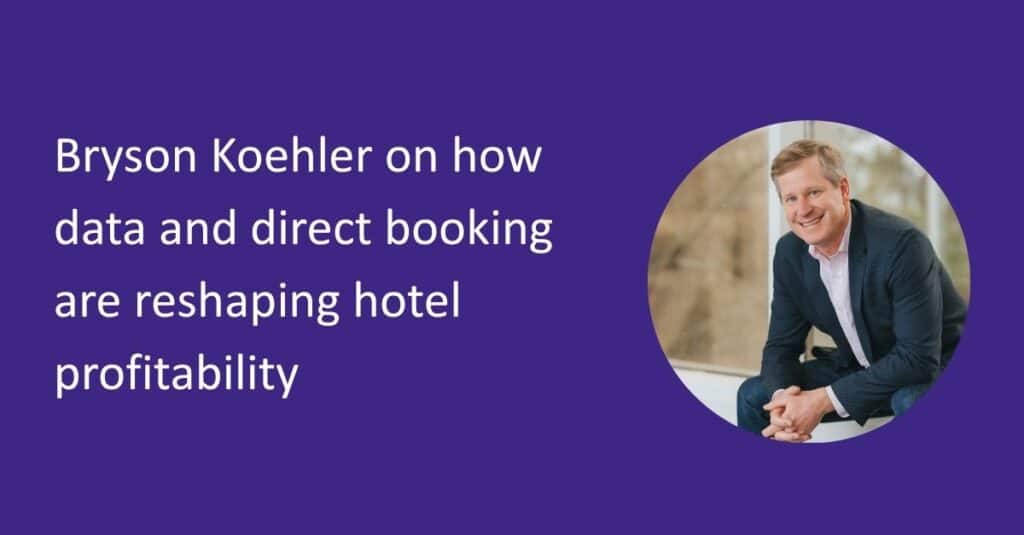
Bryson Koehler on how data and direct booking are reshaping hotel profitability
PACE Dimensions’ conversation with Bryson Koehler, Chief Executive Officer at Revinate: reversing hotels’ growing dependency on OTAs isn’t just a distribution question, it’s a fundamental commercial reset and the hotels that treat guest data as a strategic asset are the ones best positioned to make it happen.
When Bryson Koehler took the helm at Revinate, he brought with him an unusually broad perspective on the power of data. A career that has spanned business consulting at Arthur Andersen, a decade at IHG, and senior roles at The Weather Company, IBM, and Equifax has given him a lens that cuts across industries — and a conviction that the hospitality sector has barely scratched the surface of what data-driven decision-making can deliver.
Today, as Chief Executive Officer of Revinate, Koehler leads a business that drives over $5 billion in direct revenue annually for hotels around the world. In a recent conversation on the Setting the PACE podcast with Tim Davis MBE, he offered a frank assessment of where the hotel industry stands commercially, what structural forces are reshaping the market, and why the window for action has never felt more urgent.
From Guest Feedback to Direct Booking Platform
Revinate’s journey is one of purposeful evolution. The business began as a guest feedback and reputation surveys platform — a tool hotels used to understand what guests thought after they had stayed. Over time, it expanded into CRM and marketing, and today it operates as what Koehler describes as a direct booking platform, powering voice, email, web and messaging channels for thousands of hotels worldwide.
“Our fundamental goal is to help hotels drive direct business — business to their direct channels, which are their most profitable channels,” Koehler explains. “The channels where they usually get one of the best ADRs, where they have the lowest fees and costs of acquisition, and the ability to really own that guest relationship.”
The engine behind all of it is data. Revinate collects information from hundreds of on-premises and cloud-based systems to build what Koehler calls a rich, 360-degree view of each guest — understanding not just who they are, but what they like, how they behave, and what they are most likely to respond to. That data then powers personalised marketing campaigns, win-back strategies and voice channel interactions, all designed to bring guests back through the hotel’s own channels rather than through a third party.
Critically, Koehler is emphatic that the data always belongs to the hotel. “We’re not here to build our brand. We’re not here to disintermediate a hotel’s brand. We’re here to give them the tools to build their brand, establish those direct guest relationships and drive profitability.”
Structural Shifts That Cannot Be Waited Out
Koehler has spent enough time in the industry to have lived through multiple cycles of disruption — SARS, the 2008 financial crisis, terrorism, geopolitical instability. His observation about all of them is the same: they were temporary. The market always reverted to the mean.
Post-COVID, he believes something different is happening. “I think we’re in a structural shift that hotels and owner groups and management teams can’t just wait this one out.”
The evidence is in the cost base. Capital, labour, energy, insurance, food and maintenance costs have risen sharply since the pandemic and show no sign of reverting. At the same time, rate growth has not kept pace. The result is a sustained decline in net operating income across the asset base — a compression that leaves hotel owners with less room to invest, less margin for error, and a growing need to find revenue from more efficient sources.
Against that backdrop, the economics of OTA dependency have become increasingly difficult to justify. What was once a commission rate of 10 to 12 per cent has, when all fees and promotional costs are factored in, crept to 20, 25 or even 30 per cent in some cases. Meanwhile, hotel digital marketing spend sits at around £6 billion globally, compared to an estimated £23 billion spent by the major OTAs. The asymmetry is stark.
“Where is the money going to come from?” Koehler asks. “My view is the money needs to come from share shift back to your direct channels.”
Consumer Behaviour in a High-Price, High-Expectation Environment
The challenge is compounded by a fundamental shift in guest expectations. Overall guest satisfaction across the industry has declined every year since 2019, even as rates have risen. Koehler’s explanation for the disconnect is blunt: guests are paying five-star prices for what are often three-star experiences.
“You’re walking into that mid-scale environment expecting a luxury experience, because that’s what you’re paying for,” he observes. “And I think that level of frustration, we see it in guest satisfaction scores. We see it in review sentiment analysis overall.”
The internet and, increasingly, AI-powered search tools have accelerated this shift. Consumers today are conducting deeper research than ever before, reading more reviews, scrutinising individual properties rather than simply relying on brand consistency, and making more considered choices. The old promise of brand uniformity has been weakened by the operational challenges of the post-pandemic period, and guests have noticed.
Koehler’s prescription is a return to fundamentals. “The desire to deliver fantastic, hospitable experiences should always be paramount. We’re in the hospitality business. We’re here to be hospitable to our guests and give them a unique, personalised experience.” That means finding ways to reinvest in people and property — consistently, not just on the newly renovated floor or when a particularly motivated member of staff happens to be working the front desk.
The Loyalty Reckoning
Few topics elicit a more candid response from Koehler than loyalty programmes. His view is that the traditional points-based model — what he describes with some affection as “frequency-based bribery” — has run its course.
The original logic was sound enough. In an era when recognising guests across disparate systems was technically difficult, a unique loyalty identifier served a genuine operational purpose. The points mechanism that grew up around it gave hotels a way to incentivise repeat bookings at a lower cost of acquisition than winning new guests. But the model has been stretched and devalued to the point where the promise it once made can no longer be reliably delivered.
“Points have been devalued greatly, such that it’s harder to redeem, and the recognition that you’re supposed to get as a gold, platinum, diamond member are infrequent and not consistent at all,” Koehler notes. He points to Accor’s ‘disloyalty’ programme as an example of the kind of innovation the industry needs more of — turning the traditional model on its head by leading with guaranteed benefits rather than asking guests to earn their way to recognition.
For Koehler, the real measure of loyalty is far simpler than any points balance. “A guest walking into a hotel wants to be recognised, wants to feel special and wants to be rewarded. And I think the reward of a great experience with great people at a great property is worth far more than 300 points that are devalued and not really getting you the redemption opportunities that you once had.”
The operational challenge — arming frontline staff with the information they need to deliver on that promise in the moment — is where technology has a critical role to play.
Marketing Maturity: Still Early Innings
Ask Koehler where the hotel industry sits on the marketing maturity curve and his answer is disarmingly honest. With more than 13,000 hotel customers worldwide, Revinate has a broader view of industry capability than almost anyone. His assessment: the industry is at the top of the second inning.
Perhaps 10 to 15 per cent of hotels are genuine leaders — operating with sophisticated data infrastructure, personalised one-to-one marketing and a clear strategy for reducing OTA dependency. The majority are still working out how to pull their data together in the first place, let alone use it to drive meaningful commercial outcomes.
This matters because consumer behaviour is moving quickly in the other direction. Travellers are already using AI tools to research and plan trips, bypassing traditional search engines in ways that are only going to accelerate. The question of how a hotel shows up in an AI-generated summary — “best family hotel in San Diego”, for example — is becoming as commercially important as where it ranks on Google. And the answer to that question is determined by data: guest surveys, PMS records, point-of-sale data, spa and restaurant information, all woven together into a coherent picture of who loves a property and why.
“It starts with getting your data really organised, making it actionable, and connecting it to your channels,” Koehler says. “If you do that, you’re going to be able to stay very current with what we’re seeing change really, every day out on the internet.”
AI: Augmentation, Not Replacement
On AI, Koehler occupies a position that is simultaneously enthusiastic and cautious. He has no doubt that AI will be profoundly disruptive across many industries. In hospitality, however, he draws a firm distinction between the use cases where it genuinely adds value and those where it risks undermining the very thing guests are paying for.
“If you had a robot checking you in at your next property — and maybe that robot had the perfect script, had all of the data and was programmed to make you feel warm and welcomed — I’m not sold that from a human connection perspective, that’s what we’re paying for,” he says. “Humans are social creatures, and I’m not sold that we’re ready to replace those social connections with bots.”
In back-of-house functions, the case for AI is compelling. Rate management, marketing segmentation, AI-assisted copywriting, real-time coaching for call centre agents — these are areas where the technology can materially improve efficiency and output without touching the guest relationship directly. Revinate’s recently launched AI composer, for instance, helps hotel marketing teams generate campaign copy faster and more effectively than before.
The goal, as Koehler frames it, is not to replace hospitality’s people but to make them better at their jobs. “We want to help make your staff superheroes. And we think AI can really help.” But he is clear that the front line — the moment of check-in, the dinner service, the concierge conversation — remains a fundamentally human space, and that the industry should resist the temptation to automate it prematurely.
A Clear Commercial North Star
Revinate’s ambition under Koehler’s leadership is expressed in a single metric: helping every hotel customer shift at least 15 per cent of their OTA business back to direct channels. Currently, the platform delivers roughly half that on average. Closing the gap is the product roadmap.
Recent launches — including a customer data platform with enhanced AI-driven segmentation and the AI composer tool — are designed to accelerate that shift. The underlying logic is straightforward. In an environment where costs are rising, net operating income is under pressure, and reinvestment in people and property has never been more necessary, the money has to come from somewhere. Reducing commission drag and rebuilding direct guest relationships is the most durable source available.
“I am very excited,” Koehler says of the next two years. “Our line of sight for how we really help consistently deliver that 15-plus per cent share shift is right on our doorstep. And frankly, it couldn’t come at a better time, given the challenges that are going on in the industry today.”
It is a message grounded in commercial reality rather than optimism for its own sake — which, given the weight of structural headwinds the industry is navigating, may be exactly what hotel owners and management teams need to hear.
PACE Dimensions is expert in opportunity identification and prioritisation, business architecture and design, operating model design, transformation delivery, and change management. Find out more about how PACE Dimensions can help your business excel at www.pacedimensions.com