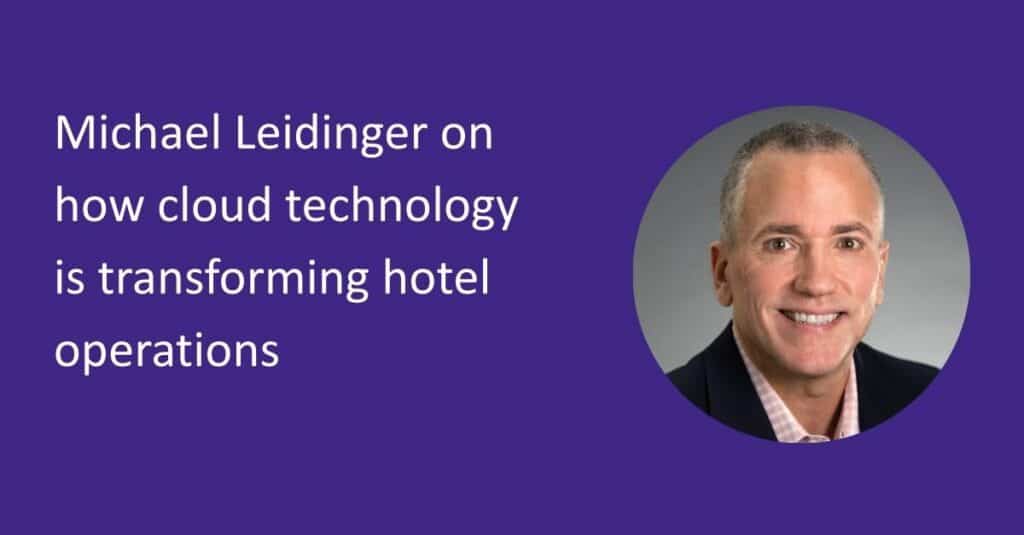
Michael Leidinger on how cloud technology is transforming hotel operations
PACE Dimensions’ conversation with Michael Leidinger, Senior Vice President and Chief Information Officer at Hilton: successful innovation at scale isn’t about forcing technology on every guest or building every system in-house, it’s about architecting flexible cloud-based infrastructure that enables guest choice whilst deploying innovations across thousands of properties in days rather than years.
When Michael Leidinger joined Hilton 15 years ago, he brought an unconventional background to the hospitality industry. A former nuclear engineer in the US Navy’s submarine service, followed by stints at major technology companies like America Online, his diverse career path has shaped his approach to driving innovation at one of the world’s most recognised hotel brands.
Today, as Senior Vice President and Chief Information Officer, Leidinger oversees Hilton’s global technology estate, spanning everything from software and network engineering to customer platforms and information security. In a recent conversation on the Setting the PACE podcast, he offered a rare inside look at how Hilton is navigating the complex intersection of cloud technology, artificial intelligence, and operational excellence across a vast global portfolio.
The Renovation Journey: Rethinking Architecture from the Ground Up
Six or seven years ago, Hilton embarked on what Leidinger calls a “renovation journey”, a fundamental shift in technology architecture that would reshape how the company operates. The challenge was clear: move away from legacy monolithic systems, hosted in single data centres with property management systems running on client-server environments, towards something far more flexible and scalable.
“We were really driving to a much more flexible, scalable architecture, leveraging the cloud, basically putting all of our services in cloud environments,” Leidinger explains. The transformation focused on creating an API-driven, microservice-enabled architecture that could support rapid innovation across Hilton’s global estate.
The journey began with the reservation and distribution system, followed by websites and mobile applications. Today, approximately 85% of Hilton’s total workload runs in the cloud. But the most significant milestone has been the modernisation of the property management system itself.
Property Engagement Platform
For years, Hilton operated OnQ, a proprietary property management system that served the company well but came with considerable technical debt. “Some of the major releases would take us up to close to a year to deploy across our global estate,” Leidinger recalls. For a company constantly innovating, these lengthy deployment cycles became increasingly untenable.
Rather than building entirely from scratch, Hilton partnered with a company that had already deployed a functional PMS to around 2,000 properties, using it as the core engine whilst developing Hilton-specific innovations around it. The result is the Property Engagement Platform (PEP), now live in almost 5,300 properties worldwide, with full deployment expected by the end of 2026.
The transformation has been dramatic. “We’re doing releases twice a month,” Leidinger notes. “Every time we do a release where we’re adding enhancements and new features, we do one release, and that’s available to all 5,300 properties that day.” This velocity represents a quantum leap in Hilton’s ability to deploy innovations at scale.
Guest Choice: Technology as an Enabler, Not a Mandate
Whilst Hilton has invested heavily in digital capabilities, Leidinger is careful to frame technology as an enabler rather than a replacement for human interaction. The Hilton Honours app serves as the hub of guest self-service and control, allowing travellers to select rooms, complete check-in formalities 24 hours in advance, and use digital keys to access their rooms without visiting the front desk.
“I’m an introvert,” Leidinger admits. “So I can arrive at a property, go right to my room, never interact with anyone, do my digital checkout and leave.” But he recognises that not all guests want this experience. “A lot of our folks think about the business traveller who has been spending an entire week on the road, going from hotel to hotel. Many times, that engagement at the front desk could be the only time they talk to a human being.”
This philosophy of guest choice extends to Hilton’s Connected Room experience, now available in over 3,000 properties, which allows guests to control their room environment through their phone. The system even personalises the in-room entertainment system, greeting guests by name and loyalty status when they enter their room.
The Two A’s: APIs and Artificial Intelligence
When asked about technologies that will have the greatest impact on hospitality’s future, Leidinger identifies two that both begin with ‘A’. The first is Application Programming Interfaces. “Being able to build your foundation on those APIs allows rapid integration,” he explains. In a complex resort with multiple point-of-sale systems, spa and golf booking systems, and cabana reservations, APIs vastly simplify operations and enable seamless digital delivery.
The second is artificial intelligence, though Leidinger is quick to distinguish between the AI hospitality companies have used for years and the emerging potential of generative and agentic AI. On the generative side, Hilton is experimenting with tools that allow guests to plan their stays more intuitively, such as asking, “I want a golf holiday in South Carolina, and I have 100,000 Honours points, where should I go?”
Agentic AI holds particular promise for operational efficiency. “Being able to lean into agentic AI and developing and running agents so that they are always processing in the background, being able to handle things, make actions, serve customers, that helps deliver great operating efficiencies,” Leidinger says. Intelligent bots already handle basic inquiries through voice channels and messaging platforms, answering questions like “What time is breakfast?” or “Is the pool open?” This frees property staff to focus on delivering personalised service rather than responding to routine queries.
Build, Buy, or Customise
Hilton’s approach to the classic build versus buy question has evolved considerably. Historically, the company built nearly everything itself. Today, Leidinger advocates for a more nuanced strategy that he likens to managing a retirement portfolio.
“If something is essentially a commodity function, then it’s a perfect candidate to buy,” he explains. Point-of-sale systems are an example he cites where building in-house makes no sense given the innovation available in the market. Conversely, Hilton continues to build and develop its own central reservation system (CRS) because of the strategic differentiation it provides. “We’re able to control the roadmap. We can do things like atomising our inventory. We can do things like getting really creative on how we’re doing pricing.”
The Property Engagement Platform represents the middle ground: buying core functionality and customising it extensively to fit Hilton’s specific needs. “You’re going to have some things you’re going to continue building yourself. You’re going to have some that you’re going to just buy outright, and there’s going to be this group in the middle where you’re going to buy the functionality and then customise it.”
Innovation at Scale: The Critical Foundations
For companies seeking to innovate at scale, Leidinger outlines several non-negotiable foundations. An API framework and microservices approach form the base layer, with data at the core. But he also makes a strong case for cloud infrastructure that goes beyond simple scalability.
“As the world becomes more and more digital, and you have a global customer base, it is paramount that you put content and functionality as close to the edge, as close to the customer as possible,” he argues. Hilton now deploys in cloud environments in every region where it operates, driving performance improvements, reducing latency, and enhancing the digital experience.
Perhaps most critically, Leidinger emphasises the importance of robust data architecture, particularly as AI becomes more central to operations. “To make all of that work, they have to act, and they have to have access to all the data. Having a big, robust data lake with the right architecture is essential to feeding all of those generative AI and agentic AI solutions.”
Personalisation with Permission
Personalisation remains a major focus for Hilton, but Leidinger is careful to underscore that it must be done “with the customer’s consent” and “in a way that’s effective and not creepy.” The company uses customer data to deliver more customised marketing messages and offers tailored to individual preferences, but only for those who have opted in.
On property, personalisation means recognising loyalty status, understanding guest preferences, and providing appropriate acknowledgement. The Connected Room experience exemplifies this: when a guest walks into their room, the television greets them by name with their loyalty status. “I mean, that’s just a great feeling, that recognition and knowing that you’re being listened to,” Leidinger notes.
The Privacy Puzzle: Navigating a Fragmented Regulatory Landscape
Whilst much attention focuses on technology innovation, Leidinger identifies evolving privacy regulations as one of the most significant challenges facing global hospitality companies. Different countries are enacting contradictory policies, with an emerging trend towards data localisation that runs counter to an industry built on facilitating cross-border travel.
“If you have a country where the government says, ‘If travellers are staying in this country, the data has to stay there,’ well, that creates challenges, and you have to re-architect around that,” Leidinger explains. These regulations are forcing fundamental rethinks of system architecture, data storage, and processing workflows, a trend he expects will have long-term impacts on hospitality technology strategies.
Sustainability and Social Impact
Hilton’s commitment to sustainability extends beyond rhetoric to measurable action through its Travel with Purpose initiative. The LightStay platform tracks, analyses, and reports the environmental and social impact of programmes across almost 9,000 hotels globally, earning industry recognition and awards.
Leidinger emphasises the broader social impact of hospitality: “This industry employs hundreds of thousands of people around the world, and when we talk about all the great growth that Hilton has had, we always have to remember that every hotel we’re opening is bringing jobs to the community and helping us be responsible members of that community.”
Prioritisation and Trade-offs
When asked about the most challenging aspect of his role, Leidinger doesn’t hesitate: prioritising technology demands across brands, regions, and functions. Hilton employs a Demand Review and Prioritisation Process that involves a lightweight intake form where stakeholders explain requirements, impacts, benefits, and costs. A senior leadership team then evaluates demands against corporate KPIs and 18-month objectives.
“No company is ever going to be able to satisfy all their demand for technology,” Leidinger admits. “And conversely, no company’s ever going to be able to afford every single thing they want to get done in one year.” The process isn’t static; the team revisits priorities at least quarterly to evaluate new demands and adjust accordingly.
It’s a candid admission from a senior technology leader, and one that resonates across the industry. The challenge isn’t simply technical; it’s strategic, requiring constant trade-offs between long-term objectives and short-term needs, between innovation and operational stability, between what’s possible and what’s practical.
Looking Ahead
Despite hospitality’s maturity, Leidinger sees tremendous potential for continued disruption and innovation. “I’ve seen more change and more innovation and more disruption in the last three years than in my previous 12 years in the industry,” he observes. Start-ups are innovating across property management and point-of-sale systems, challenging comfortable incumbents.
One area where Leidinger believes the industry could accelerate progress is through standardisation. “We don’t have a common industry standard” for APIs, he notes, meaning companies must constantly tweak specifications and make accommodations. “The entire industry would benefit from a standard set of API specifications that everyone can build to.”
As hotels continue their digital transformation, Leidinger’s perspective offers a valuable reminder that technology serves its highest purpose when it enhances rather than replaces human connection. Whether a guest chooses to go straight to their room or engage with staff at the front desk, the goal remains the same: delivering a hospitable, reliable stay experience that makes travel more enjoyable.
From his unconventional start in submarine nuclear engineering to leading technology strategy for a global hospitality giant, Michael Leidinger’s journey reflects the increasingly interdisciplinary nature of modern technology leadership. As Hilton completes its cloud transformation and explores the frontiers of AI, his emphasis on architectural discipline, guest choice, and strategic prioritisation provides a blueprint for innovation at scale that extends far beyond a single company or industry.
PACE Dimensions is expert in opportunity identification and prioritisation, business architecture and design, operating model design, transformation delivery, and change management. Find out more about how PACE Dimensions can help your business excel at www.pacedimensions.com