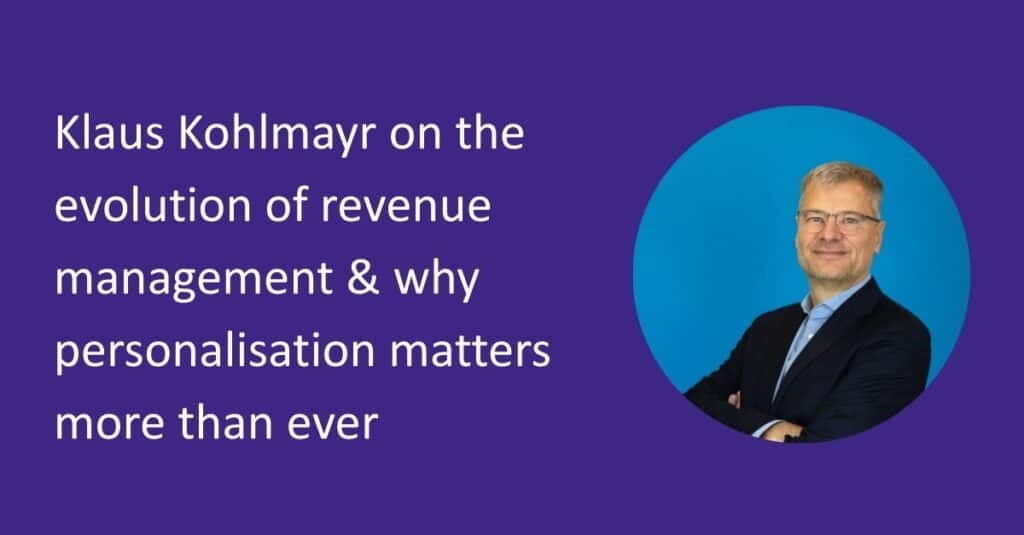
Klaus Kohlmayr on the evolution of revenue management & more
As hotels grapple with the dual imperatives of technological transformation and human-centred service, one message emerges with striking clarity from leading travel and hospitality management consultancy PACE Dimensions’ conversation with Klaus Kohlmayr, Chief Evangelist and Development Officer at IDeaS Revenue Solutions: the future of revenue management isn’t about algorithms replacing intuition, it’s about technology enabling better commercial decisions at scale.
There’s something quietly radical about Klaus Kohlmayr’s career trajectory. In an industry characterised by executive mobility, where leaders routinely hopscotch between brands and markets, Kohlmayr has spent nearly two decades at IDeaS Revenue Solutions, watching the company transform from a modest operation of 180 people serving 1,000 hotels into the undisputed leader in revenue management and pricing solutions. More significantly, he’s positioned himself at the intersection where technological possibility meets commercial reality: a vantage point that yields insights few in hospitality can match.
What becomes immediately apparent in conversation with Kohlmayr is his unusual ability to translate complex technological concepts into pragmatic business imperatives. Where others might get lost in the technical capabilities of artificial intelligence or the architectural intricacies of cloud infrastructure, Kohlmayr consistently returns to fundamental questions: What business problems are we actually trying to solve? How does this technology enable hoteliers to serve guests better? What does personalisation truly mean when you’re not exploiting customers?
His perspective is shaped by an uncommon blend of operational hotel experience, regional revenue management leadership, and nearly two decades immersed in the evolution of revenue management technology. It’s a combination that allows him to speak fluently to both the Chief Commercial Officer worried about competitor rate positioning and the startup founder building the next generation of hospitality technology.
The accidental revenue manager
Kohlmayr’s entry into hospitality carried the straightforward practicality typical of Austrian career planning. Growing up in a medium-sized village near the Slovenian and Italian borders, where Austria’s second-biggest industry is travel and tourism, hotel management school represented a sensible path.
“I joined the Hotel Management school at 15, partly because my parents didn’t know what to do with me, so they stuck me in there, which I agreed to,” Kohlmayr recalls with characteristic directness. By 19, he’d completed his degree and was working summers at various hotels, building the operational foundation that would later prove invaluable.
What followed was the kind of international experience that shapes hospitality careers: the United States, Switzerland, Vienna, back to the US, London, Paris, Singapore, Geneva, and eventually settling in America for the past 15 years. Along the way, he worked in independent hotels and large chains, ultimately landing at InterContinental Hotels.
However, it wasn’t the operational aspects of hotel management that captured Kohlmayr’s imagination. It was the relationship between demand and price, and how pricing could influence guest behaviour. Revenue management didn’t yet exist as a formal discipline, so Kohlmayr began building his own Excel-based programmes to understand patterns in guest behaviour.
“I was fascinated about the relationship of demand and price and how you can influence guest behaviour through pricing,” he explains. This wasn’t merely academic interest; it was practical problem-solving driven by genuine curiosity about how hospitality economics actually worked.
The pivot came whilst running the front office at the InterContinental Paris. The general manager, noticing Kohlmayr’s passion for pricing and demand, made a characteristically French observation: “Listen, I’ve noticed you’re really passionate about this. Why don’t you do it full time and leave the operational side up to somebody else?”
That decision launched Kohlmayr into revenue management at the regional level, eventually leading the function for IHG Asia Pacific from Singapore. By 2007, he’d made the logical next move: if he wanted to dedicate himself fully to revenue management, he should join a company entirely focused on it. IDeaS, then a relatively small operation, offered that opportunity. Nearly two decades later, he’s still there, having witnessed and shaped much of the industry’s evolution in pricing and revenue optimisation.
Chief Evangelist: A role without precedent
The title “Chief Evangelist” doesn’t appear on many organisational charts in hospitality. Kohlmayr’s role represents something genuinely distinctive: a position explicitly designed to facilitate dialogue between IDeaS, its clients, technology partners, industry stakeholders, and the broader hospitality ecosystem.
“We created this role of Chief Evangelist to have a dialogue between people about what is important, what should people in the industry be paying attention to, what’s coming down the road,” Kohlmayr explains. It’s a role that requires unusual breadth: understanding where technology is heading, recognising emerging commercial strategies amongst leading brands, identifying startup innovations that might reshape competitive dynamics, and synthesising all of this into coherent perspective on industry direction.
In practice, this means Kohlmayr spends substantial time in conversation with Chief Commercial Officers at major hotel brands, consultants reshaping industry practice, technology companies building the next generation of hospitality infrastructure, and startups attempting to disrupt established approaches. He’s simultaneously observer and participant, industry analyst and technology strategist.
“I just try to understand what is happening in the industry, and then communicate that back to the industry and say, with what I’m seeing and what I’m hearing, here are the trends that I think will happen in the next few years,” Kohlmayr notes. This positioning enables him to identify patterns emerging across multiple conversations and contexts: the weak signals that become strong trends.
The role also reflects a fundamental shift in how revenue management technology companies must operate. In an earlier era, building superior algorithms and delivering reliable systems sufficed. Today, success requires understanding not just where technology can go but where the industry needs it to go, and how technological capability translates into genuine business value.
The post-COVID imperative: Personalisation, merchandising, technology
When asked about the biggest mindset shifts hoteliers need to make, Kohlmayr immediately identifies three interconnected imperatives: personalisation, merchandising, and leveraging technology to accelerate innovation and create more personalised guest experiences.
“The mindset shift in consumer behaviour is all around personalised experiences and being treated like an individual when you’re travelling and you’re staying in a hotel, and you can see that shift now taking place in the industry,” Kohlmayr observes. This isn’t merely aspirational positioning; the evidence manifests across multiple dimensions of hotel operations and strategy.
Leading brands are making substantial technology investments. Marriott, Hilton, and Accor have all committed significant capital to digital infrastructure. Regional operators worldwide are following suit, recognising that technology represents competitive advantage rather than mere operational necessity.
Perhaps most tellingly, the industry’s merger and acquisition activity reveals strategic priorities with unusual clarity. “If you look at all the acquisitions and all the additions and brand creations that have happened over the last couple of years, almost all of that is in the lifestyle segment,” Kohlmayr notes. These lifestyle brands speak directly to personalisation imperatives and consumer demand for authentic experiences.
For Chief Commercial Officers, this reality creates concrete operational challenges. The question is no longer whether to merchandise hotel rooms and ancillary revenue opportunities, but how to do so effectively through digital channels using technology that enables personalisation at scale.
This represents a fundamental expansion of what revenue management encompasses. Traditional revenue management focused narrowly on room pricing optimisation. Contemporary revenue management must consider the entire commercial ecosystem: rooms, function space, groups, ancillary revenues, profitability levers, marketing, distribution, loyalty, and sales opportunities.
Personalisation versus exploitation: Where’s the line?
The conversation around personalised pricing inevitably encounters a thorny question: when does personalisation become exploitation? If hotels can identify what individual customers are willing to pay, what prevents them from simply extracting maximum willingness to pay rather than offering fair market value?
Kohlmayr’s response reframes the question in ways that challenge assumptions about how personalised pricing actually works. “Does truly personalised pricing, pricing for the individual, exist today? No, it doesn’t,” he states emphatically. Current personalisation operates not at the individual level but through behavioural cohorts.
The model resembles what consumers already experience with Netflix or Amazon: people with similar behaviours receive similar recommendations and, in commercial contexts, similar pricing. “Personalised pricing at this point is based on behaviour that you match compared to a segment or a cohort of people,” Kohlmayr explains.
More fundamentally, Kohlmayr argues that exploitation through pricing represents a logical impossibility given basic market dynamics. “There is a value-price balance, and you have to make sure that the value and the price match. If they don’t match, then you don’t get the sale, right, or you don’t convert the booking.”
Customers react to perceived value mismatch by not purchasing. This basic economic reality constrains pricing regardless of what hotels might theoretically want to charge. “You will never be able to exploit people through pricing, because people will react with their feet and say, ‘I’m not going to accept that mismatch in value,’” Kohlmayr notes.
The key to effective personalisation lies in understanding needs and positioning offers accordingly. A family travelling with children requires different products and services than a solo business traveller. Understanding those distinct needs and offering appropriate solutions at prices that reflect genuine value: that’s personalisation done properly.
Consumer sophistication and the evolving revenue manager
The post-COVID travel landscape has produced more sophisticated consumers who understand dynamic pricing, recognise they have abundant choice, and actively seek unique experiences. This sophistication manifests in spending behaviour that would have seemed remarkable a decade ago.
“When I go to a concert or I go to a sports event, I can see people spending lots of money on things that are entertaining to them and that provide them with a great experience,” Kohlmayr observes. Consumers demonstrate willingness to pay premium prices when they perceive genuine value. The challenge for hotels is delivering experiences that command that premium.
This consumer evolution necessitates parallel evolution in the revenue manager role. The function has expanded from narrow room pricing focus to comprehensive commercial mindset encompassing diverse revenue streams and profitability levers.
“It’s understanding the different revenue taps that you have at your disposal and the leverage you have at your disposal across pricing for rooms, function space, groups, auxiliary revenues, understanding the profitability levers for the margins, understanding the marketing, distribution, loyalty and sales opportunities you might have,” Kohlmayr explains.
Perhaps more significantly, decision-making is increasingly moving above property level. Mid-size and global chains are building infrastructure that enables revenue management decisions for 50, 100, or hundreds of hotels through centralised teams rather than dedicating one revenue manager per property. This shift requires systems capable of operating at scale whilst maintaining property-level nuance.
However, Kohlmayr identifies a critical gap that limits revenue management’s strategic impact: communication capability. “Revenue managers, from a personality and character point of view, are not always the most articulate or the biggest storytellers,” he notes candidly.
Revenue managers sit on treasure troves of demand intelligence. They understand future booking patterns, identify demand gaps, and can pinpoint where commercial focus should concentrate. Translating that data-driven insight into compelling narratives that influence marketing, sales, and executive decision-making: that’s where many revenue managers struggle.
“We need revenue managers that are good storytellers, that can interact with the marketing teams and the sales teams and the other leaders in a hotel to help them understand, through the data that they have, where are the biggest opportunities, where should they be focused on, where should they spend the next marketing dollar for the biggest return on investment,” Kohlmayr emphasises.
The persistent siloing of revenue management from marketing represents one of hospitality’s most stubborn organisational challenges. “When we talk to clients, or when I talk to commercial leaders in the industry, the number one question I always get asked is, ‘When are we going to bring revenue management and marketing closer together?’” Kohlmayr shares.
Progress is happening, particularly where companies have installed leadership overseeing both commercial and technology functions. However, the integration remains frustratingly incomplete at many organisations.
The legacy systems problem: APIs, cloud, and complexity
If there’s a recurring source of frustration in Kohlmayr’s assessment of hospitality technology, it centres on the persistent limitations of legacy systems, and even some ostensibly modern systems, that constrain sophisticated revenue management.
“I’m always surprised that even the latest generation and new generation systems many times don’t have the capabilities that are required to have some of these more sophisticated pricing capabilities,” Kohlmayr notes. Systems lacking market segmentation, overbooking capabilities, or last room value functionality create genuine operational constraints.
These aren’t esoteric requirements. They represent foundational capabilities that revenue management practitioners have relied upon for 25 or 30 years. Their absence in contemporary systems reflects inadequate understanding of actual revenue management requirements.
Kohlmayr’s wish list for property management systems, central reservation systems, and internet booking engines centres on three priorities: modern APIs, cloud-based infrastructure, and open approaches enabling rapid capability additions.
The integration complexity creates substantial operational friction. “One of the biggest roadblocks that we encounter is when we have a new hotel that we want to add on and we have to build a new integration, it can take up to 18 months to get the integration capabilities built,” Kohlmayr explains. Much of this delay stems from limited resources and unnecessary complexity in integration processes.
The attribute-based pricing conversation provides a case study in how slowly hospitality technology evolves. The concept, pricing not just rooms but specific room attributes and add-ons, has been discussed for 15 years without achieving meaningful scale.
“Even after 15 years of talking about it, we don’t have it at scale yet,” Kohlmayr acknowledges. However, he detects genuine momentum building. Technology investments being made today should enable real traction within 18 months. Property management systems are slowly building capability to handle attributes efficiently. Some central reservation systems are developing necessary booking engine functionality.
“As an eternal optimist, I am quite confident that probably in ’26 or ’27 we’ll start seeing some acceleration in that area,” Kohlmayr predicts. The dynamic is familiar in hospitality technology: change happens glacially until a few major chains move, then everyone wants the capability simultaneously.
Data integration: The swivel chair problem
When discussing underutilised data sources in revenue management, Kohlmayr immediately reframes the question. The challenge isn’t insufficient data. It’s that valuable data sits in disparate systems requiring revenue managers to access multiple portals, aggregate information manually, and synthesise insights across disconnected platforms.
“The challenge is not, ‘Do I have enough data?’ The challenge is, ‘Can I have all that data in one place, and can I use that for better decision making?’” Kohlmayr explains. The old “swivel chair” problem, physically rotating between different systems to access needed information, persists despite technological advancement.
This fragmentation creates genuine operational inefficiency and undermines decision quality. Revenue managers waste time on data aggregation rather than analysis and strategy. More problematically, the difficulty of accessing and synthesising diverse data sources means potentially valuable insights remain undiscovered.
The broader ecosystem dynamics exacerbate this challenge. Hospitality benefits from an abundance of innovative vendors creating genuinely valuable point solutions. However, each vendor maintains its own data copy, inventory, customer profiles, and reporting structures. Hotels find themselves managing dozens of disconnected systems, each delivering real value individually but creating integration nightmares collectively.
“There are a bunch of great vendors creating really wonderful, innovative systems and applications, but they all demand their own sources of information. They all have their own copies of inventory and customer profiles and all that kind of good stuff,” Kohlmayr notes.
The result: technology proliferation without integration. His prescription is straightforward: “A hotel, for me, number one priority has got to be saying, ‘I need a single source of truth that I can leverage across all the different things that I want to do.’” This represents more than technical architecture preference; it’s fundamental to operational effectiveness and decision quality.
Artificial intelligence: Separating hype from reality
Kohlmayr’s perspective on artificial intelligence carefully distinguishes between genuine transformation already underway, near-term evolution, and longer-term possibilities. Unlike commentary suggesting AI will fundamentally replace human decision-making in hospitality, his assessment emphasises enhancement over replacement.
“The bigger question is when and how is it going to transform all technology systems and technology software that we’re using,” Kohlmayr observes. AI functions as a rocket engine accelerating existing systems rather than replacing them wholesale: a metaphor he borrows from Airbnb CEO Brian Chesky.
For IDeaS specifically, AI is hardly new. “We’ve been using AI since our founding 35 years ago. We’ve been using large language models and all the stuff that’s traditionally associated with AI since the beginning. That’s how our models and algorithms are built,” Kohlmayr notes. What’s changed isn’t AI capability in modelling but how users interact with AI through natural language processing and generative AI.
The productivity gains are already substantial. One team member reports saving 40% of their time through extensive AI use. Configuration processes that previously required days of manual work can now be pre-configured automatically, with revenue managers simply reviewing and approving settings in an hour or two.
Beyond customer-facing applications, AI enables significant back-office efficiency improvements. Workflow automation eliminates manual tasks. System configuration becomes dramatically faster. The cumulative effect represents genuine productivity enhancement.
However, Kohlmayr’s most emphatic point concerns AI adoption urgency. “If you don’t have AI on top of your mind, if you’re not playing with AI and using it the same way as you’re using Excel and Word and Outlook, and if you’re not putting it on your CV, if you’re looking for a job, you will be left out,” he warns.
This isn’t hyperbole. AI tools are readily available, easy to adopt, and deliver immediate productivity benefits. Professionals who fail to integrate AI into daily workflows will find themselves at growing disadvantage relative to peers who embrace the technology.
The COVID-19 pandemic accelerated an important shift in revenue management’s relationship with data. Historical demand patterns and booking behaviour, traditionally central to forecasting, became largely irrelevant. Revenue management systems had to prioritise forward-looking indicators: rate shopping data, benchmarking information, review sentiment, and external demand signals.
“A lot of the shift has happened in the last five years to prioritise other data sources like rate shopping, benchmarking data, review data and external data sources that give you an indication of future demand, and prioritise that over historical patterns and data that you’re seeing,” Kohlmayr explains.
This philosophical shift, emphasising predictive indicators over historical patterns, improves forecasting accuracy in stable periods whilst providing resilience during disruption. Any revenue manager should examine how their systems currently weight historical versus forward-looking data.
The alternative accommodation challenge
The rise of Airbnb and other short-term rental platforms created what Kohlmayr characterises as an existential moment for traditional hotels. Early industry responses often dismissed alternative accommodation as serving different customer needs or addressing distinct market segments. That comfortable assumption has proved untenable.
“Alternative accommodation does compete with hotels at all levels and across all segments,” Kohlmayr acknowledges. However, his prescription focuses on understanding rather than dismissing the competition.
Hotels must identify what alternative accommodations offer that traditional hotels cannot, then determine how to provide those benefits within hotel contexts. Hilton’s confirmed connected room product provides an instructive example. The company recognised that families and groups often choose Airbnb because they need larger, connected spaces. By guaranteeing connected rooms at booking rather than check-in, Hilton addresses a specific driver of alternative accommodation preference.
“Understanding your customer group and why they’re not staying with you is important,” Kohlmayr emphasises. This requires genuine curiosity about customer needs rather than defensiveness about product limitations.
The second imperative involves incorporating short-term rental data into demand forecasting and competitive analysis. Hotels cannot accurately understand total market demand whilst ignoring a substantial segment of accommodation supply.
“You need to feed in short-term rental data. You need to understand the total demand for your market, including the Airbnb or short-term rental components as well,” Kohlmayr explains. Companies like Key Data, Lighthouse, and Amadeus are building capability to integrate alternative accommodation data into their platforms, making this analysis increasingly accessible.
Technology partnerships: Collaboration over competition
When discussion turns to potential threats from technology giants (Google, Microsoft, Amazon) entering hospitality, Kohlmayr immediately reframes the dynamic. These companies represent partnership opportunities rather than competitive threats.
“It’s not really… I wouldn’t see that as competition. It’s more that there’s a lot of cooperation and partnership going on,” Kohlmayr notes. IDeaS maintains close partnerships with AWS and Microsoft, regular dialogue with Google. The company is AWS’s only revenue management partner with competitive competency status.
Technology giants do offer tools that organisations could theoretically use to build revenue management capabilities. However, deploying those tools effectively requires substantial internal expertise, sophisticated infrastructure, and deep understanding of revenue management principles. The tools are generalist platforms requiring specialisation for hospitality applications.
“It requires a lot of internal infrastructure. It requires experts at the hotel that understand AWS tools. It requires people that can stitch those together to make them effective, and they’re not specialised models. They are more generalist models that can be deployed towards a certain use case,” Kohlmayr explains.
For most hotel companies, partnering with specialised revenue management providers makes more strategic sense than attempting to build proprietary systems using cloud platform tools. The economics, risk, and capability requirements favour collaboration over internal development.
Innovation discipline: Productising new opportunities
How does IDeaS decide which innovations merit pursuit? The answer reveals sophisticated process rather than ad hoc opportunism. Three years ago, the company established IDeaS Lab, an innovation function staffed by six or seven people dedicated to generating new products through structured methodology.
The process began with examining 127 different industries beyond hospitality. Through systematic filtering, this initial universe reduced to 20-25 high-priority opportunities IDeaS could potentially pursue. At any given time, the Lab focuses on two or three opportunities, targeting launch of one new product annually.
“We have certain filters, like, what revenue opportunity, go-to-market accessibility, opportunity cost, what is the risk associated with it? So we have a set of criteria that we go through, and we have a gating process that we have in the company that gives us the thumbs up or down along the way,” Kohlmayr explains.
Results validate the approach. Last year saw launch of a cruise revenue management solution in partnership with Virgin Voyages. IDeaS recently announced Spotlight, a marketing revenue management product launching later this year. Additional products in development should emerge in 2026 and 2027.
This systematic innovation process, what Kohlmayr characterises as “productising innovation”, provides structure and discipline to opportunity evaluation. Rather than pursuing whatever seems interesting, IDeaS applies consistent criteria evaluating revenue opportunity, market accessibility, opportunity cost, and risk.
Evolving beliefs: Technology’s limits and possibilities
Having spent decades immersed in hospitality technology, Kohlmayr has revised certain assumptions about technology’s role in hotel operations. A conversation he recalls from 1998 at the InterContinental Paris crystallises the evolution.
The general manager pointed at the concierge desk, populated by quintessentially French concierges, and predicted their roles would disappear within five years, replaced by technology. “That conversation happened in 1998,” Kohlmayr notes. “And if you go to what is now the Westin in Paris today, the same people stand behind the concierge desk, and they’re still doing their job, and a great job, by the way.”
The prediction proved spectacularly wrong, not because technology failed to advance but because the prediction misunderstood what hospitality fundamentally is. Yes, Google Maps now provides restaurant information. Yes, numerous digital tools enable self-service travel planning. Yet substantial numbers of guests still want human interaction, still value the concierge’s judgement, still prefer personal service to digital efficiency.
“Technology can help in a lot of areas, but hospitality is still about people serving people, and you need the right… There are some things that can never be replaced,” Kohlmayr reflects. This realisation has fundamentally shaped his philosophy on technology deployment.
The principle extends throughout hotel operations. Technology should enhance human service, not replace it. AI should enable better guest experiences by freeing staff from routine tasks, allowing them to focus on complex needs requiring judgement and empathy. Systems should support rather than substitute for human decision-making.
“You have to keep the human in the loop as you’re looking at technology and use technology to enable better service, not replace service,” Kohlmayr emphasises. This represents more than diplomatic positioning about job security. It reflects genuine understanding that hospitality’s value proposition fundamentally centres on human interaction, emotional connection, and personalised service that technology can enhance but cannot replicate.
When asked about alternative career paths, Kohlmayr considers two possibilities that reflect his ongoing passion for hospitality: running a hotel or owning one. Both represent return to operational hospitality from the technology side.
However, his retirement dream reveals something deeper about what draws him to the industry. “If I retired tomorrow, if you would ask me, ‘What would I love to do?’ I would probably love to open a coffee shop and just be there for people, more for the community, not to make a lot of money, but to have a community-oriented hospitality type business, like a coffee shop that would serve the community,” Kohlmayr shares.
This vision, serving community rather than maximising profit, creating space for human connection rather than optimising revenue per square foot, encapsulates a hospitality philosophy that transcends commercial imperatives. It recognises that hospitality, at its core, is about creating space for human interaction, providing service that improves people’s days, and building community through consistent presence and genuine care.
It’s a philosophy notably absent from much industry discourse around optimisation, efficiency, and technology deployment. Yet it may represent the most important reminder of what separates genuinely excellent hospitality organisations from merely competent ones.
The human element in the age of algorithms
As our conversation draws to a close, Kohlmayr returns repeatedly to a theme that animates much of his thinking about hospitality’s technological future: the irreducible importance of human service and decision-making.
Revenue management has become increasingly sophisticated, powered by algorithms that process vast data sets and identify patterns human analysts would miss. AI enables personalisation at scale, automation of routine tasks, and prediction accuracy that improves continuously. Yet the most critical decisions (how to position a hotel, what guest experiences to prioritise, how to balance short-term revenue optimisation against long-term brand building) remain fundamentally human judgements.
“AI is there to help me solve the business challenges I have in my own business,” Kohlmayr states. The framing is critical. AI functions as a tool for addressing identified problems rather than a solution seeking problems to solve. This orientation ensures technology serves business strategy rather than dictating it.
The principle extends throughout hotel operations. In an era of increasing automation, the properties that succeed will be those that deploy technology to enhance rather than replace human service. They’ll use AI to free staff from repetitive tasks so they can focus on complex guest needs requiring empathy, judgement, and genuine human connection.
For revenue managers specifically, technology should enable better storytelling: using data to identify opportunities, communicate insights to commercial colleagues, and influence strategic decisions. The systems should surface patterns, automate routine pricing decisions, and provide decision support. But the strategic judgements about positioning, target segments, and commercial priorities remain human responsibilities.
Looking ahead: Merchandising’s acceleration
When asked about the next few years’ most significant evolutions, Kohlmayr identifies merchandising and personalisation as areas primed for acceleration. Hotels are finally developing the digital capability and technology infrastructure to “sell anything to anyone who wants to stay at my hotel,” as he puts it.
This evolution extends beyond room pricing to encompass the entire commercial ecosystem. Upselling and cross-selling become systematised rather than opportunistic. Ancillary revenue opportunities receive the same sophisticated approach as room revenue. The automation exists to price all these elements dynamically based on demand patterns and customer preferences.
For Chief Commercial Officers, this creates both opportunity and requirement. The opportunity lies in accessing revenue streams and customer segments previously difficult to reach systematically. The requirement involves building the capability, infrastructure, and organisational processes to execute merchandising strategies at scale.
“The scalability of the systems and moving into the area of merchandising and personalisation, upselling, cross-selling, I do feel fairly confident it’s going to accelerate over the next few years,” Kohlmayr predicts. This isn’t speculative futurism; it’s recognition that enabling technology is finally maturing whilst commercial imperative has never been stronger.
Substance over novelty
Throughout our conversation, what emerges most clearly is Kohlmayr’s consistent emphasis on solving real problems rather than deploying technology for its own sake. His questions always return to business fundamentals: What problem are we trying to solve? How does this technology enable better guest experiences? What value does this create for hotel owners and operators?
This orientation produces insights that transcend the hype cycles dominating much technology discourse. Yes, AI will transform aspects of revenue management and hotel operations. Yes, merchandising and personalisation will accelerate. Yes, alternative accommodations require strategic response. But no, technology won’t replace the human elements that make hospitality valuable.
The organisations that navigate this transformation most successfully will be those that deploy technology to enhance their core value propositions rather than chasing technological sophistication for its own sake. They’ll invest in integration and data infrastructure rather than accumulating disconnected point solutions. They’ll develop revenue managers who are excellent storytellers as well as data analysts. They’ll maintain the human element whilst leveraging technology to serve guests better.
Having spent nearly two decades helping shape revenue management’s evolution, witnessing IDeaS grow from 180 people serving 1,000 hotels to industry leadership, Kohlmayr has earned perspective few can match. His conviction that technology should enhance rather than replace human judgement, that personalisation must respect value-price balance, and that solving real business problems matters more than deploying fashionable capabilities deserves serious attention from any hospitality leader concerned about their organisation’s competitive positioning.
Those who focus on these fundamentals whilst building genuine technological capability will find themselves well-positioned regardless of how rapidly AI and other technologies continue evolving. Those who chase technological solutions without clarity about what problems they’re solving will discover that having the latest tools provides no protection against strategic confusion.
The future Kohlmayr envisions isn’t one where algorithms replace hoteliers’ judgement. It’s one where technology enables better judgement, enhances service delivery, and creates guest experiences that were previously impossible to deliver at scale. That’s a future worth building towards.
PACE Dimensions is expert in opportunity identification and prioritisation, business architecture and design, operating model design, transformation delivery, and change management. Find out more about how PACE Dimensions can help your business excel at www.pacedimensions.com